Shared research cores are centralized laboratories on campus that provide access to specialized equipment and expert technical support that go beyond what is typically available in an individual investigator’s laboratory. To help ensure the safety of the shared facilities, core staff, and researchers who use these spaces, investigators need to update their biosafety protocol and provide hazard communication to core staff before beginning work.
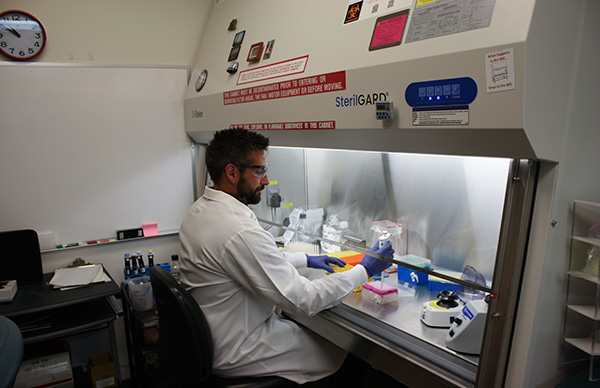
When research activities are performed in a research core facility, the investigator must:
- list the location(s) in their biosafety protocol
- include in their research description which biological materials will be handled in the core facility
- detail if laboratory personnel will perform activities in the shared space or if core staff will perform activities with the investigator’s biological materials.
Hazard communication to core staff is necessary when materials are transferred to a shared laboratory space. The investigator using the shared research core will need to provide information on:
- biological materials (e.g., source, modifications, antibiotic resistance, live/fixed, biosafety level).
- contact information for the PI or laboratory personnel.
- method of disinfection/inactivation for the biological materials (e.g., method of fixation, validation of fixation method).
- PPE requirements.
- occupational health considerations (e.g., respiratory protection, vaccination).
Hazard communication may take place in-person, using an online submission form, or another method, as specified by the research core. The research core may request the investigator provide their biosafety protocol before granting access to equipment or providing services.
Questions? Please reach out to biosafety at biosafety@fpm.wisc.edu or 608-263-2037
We are here to help!
by Karen Demick
Karen Demick is a Biosafety Specialist on the IBC and Laboratory Operations team. She joined EH&S in 2011 and supports the research community through reviewing biosafety protocols and outreach to laboratories.
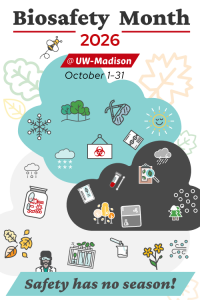
It’s Biosafety and Biosecurity Month 2026! Look out for more biosafety topics each week in October.
Safety has no season!
This year’s Biosafety Month theme is “Safety has no season!”
Learn about the latest biological safety updates that impact labs like yours on the UW–Madison campus, and print the flyer to help spread the word.
Have a biosafety question? Need help? The UW-Madison Office of Biological Safety is ready to serve you!
The UW-Madison Office of Biological Safety is a proud member of the American Biological Safety Association (ABSA).