In the bustling research environment of the University of Wisconsin–Madison, thousands of nitrile gloves are used daily across laboratories to ensure biosafety and contamination control. Nitrile gloves, made from synthetic rubber, are a staple in biological labs due to their chemical resistance and durability.
While essential for protecting researchers and maintaining sterile conditions, these single-use gloves contribute significantly to laboratory waste. This single-use nature and contamination risks have traditionally made them difficult to recycle. Most end up in landfills, contributing to the growing problem of laboratory plastic waste. Recognizing this challenge, many laboratories at UW–Madison have taken proactive steps to reduce its environmental footprint through innovative recycling initiatives.
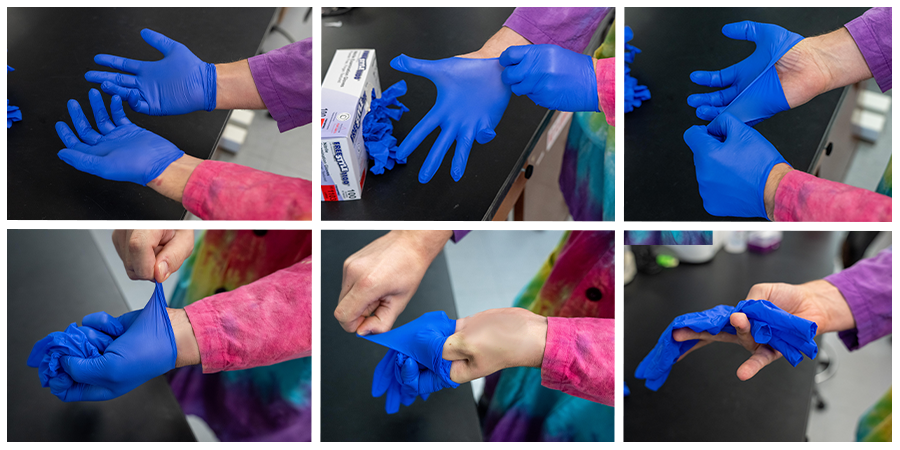
Who can participate?
Under the right conditions, some BSL-1 and BSL-2 labs can recycle nitrile gloves. If the following safety conditions are met, your lab may be able to participate:
- To be eligible for recycling, gloves must not be exposed to infectious or hazardous materials, regardless of the biosafety level.
- These labs should have separate collection containers for gloves to be recycled.
- Training must be provided on how to determine which gloves can and cannot be recycled.
Unfortunately, not every laboratory is a good fit to recycle lab gloves from the get-go. In fact, there are certain laboratories, such as BSL-3 and BSL-4 laboratories, which cannot participate in a lab glove recycling program. These labs handle high-risk pathogens, including airborne and potentially lethal agents. All gloves in these environments are considered biohazardous waste and must be autoclaved or incinerated according to strict protocols. Recycling such gloves would pose a significant risk of contamination. It is not permitted under standard biosafety and waste management guidelines.
| BSL Level | Eligible for Glove Recycling? | Conditions |
| BSL-1 | ✅ Yes | Gloves must be free of hazardous contamination |
| BSL-2 | ✅ Yes | Only if gloves are not exposed to infectious or hazardous materials |
| BSL-3 | ❌ No | Gloves are considered biohazardous waste |
| BSL-4 | ❌ No | Gloves must be destroyed due to extreme risk |
Eligible laboratories at UW–Madison can utilize several programs to recycle nitrile gloves. The two most popular programs are Ansell RightCycle™ and PolyCarbin Gamma Carbin™.
Ansell RightCycle™
The Ansell RightCycle™ Program is a large-scale recycling initiative designed to help laboratories and industrial facilities divert non-hazardous personal protective equipment (PPE) from landfills. Originally developed by Kimberly-Clark Professional, and now supported by Ansell, the program focuses on recycling used nitrile gloves in addition to PPE-like protective clothing, masks and safety eyewear — specifically those branded under Kimtech™ and KleenGuard™.
The process of nitrile glove recycling includes:
- Labs collect used Kimtech™ gloves in designated containers.
- The containers are shipped (at the participant’s expense) to a recycling partner.
- The nitrile gloves are processed into plastic pellets.
- Pellets are then used to manufacture new consumer goods like park benches, shelving and flowerpots.
Pros: Labs only pay for shipping and gain access to WasteBits®, a digital platform that tracks waste data that is helpful for generating reports.
Cons: The program only accepts Kimtech™ nitrile gloves.
Polycarbin Gamma Carbin™
Another popular program is Polycarbin’s Gamma Cabin. This program is a closed-loop recycling solution designed specifically for laboratories and healthcare facilities. While other programs only accept specific glove brands, Polycarbin accepts nitrile gloves from any manufacturer. Gloves must be non-soiled and free of biological, chemical, or radioactive contamination. To participate in this program, laboratories must pre-pay for containers and shipping labels. The nitrile gloves process includes:
- Labs collect used gloves in a designated Gamma Carbin™ container.
- Full containers are sealed and shipped using a pre-paid shipping label.
- Recycled gloves are processed into plastic pellets and used to manufacture new lab products, supporting a circular economy.
- Labs can track their impact through Carbin Counter™, a digital platform that provides real-time data on waste diversion and carbon footprint reduction.
For every pound of nitrile gloves produced, over five pounds of CO₂ are released into the atmosphere. Each Gamma Carbin™ five-pack can divert over 6,000 pairs of gloves from landfills.
Pros: Accepts any nitrile glove brand.
Cons: Containers and shipping must be pre-purchased.
Looking ahead
UW-Madison aims to increase lab participation, improve waste sorting education, and explore additional recycling streams for other lab materials. These efforts align with our broader sustainability goals and demonstrate how biosafety and environmental stewardship can go hand-in-hand.
How to get involved
Labs interested in joining a nitrile glove recycling program can visit the Ansell RightCycle™ Program or reach out directly to Polycarbin to participate. Additionally, interested labs can also join the free My Green Lab Certification program. By taking part, researchers not only protect themselves and their experiments but also contribute to a more sustainable future for science.
by Travis Blomberg
Travis Blomberg coordinates campus’ zero waste efforts. Specifically, Travis aligns sourcing/procurement practices, consumption behavior, and diversion opportunities for recoverable materials.

It’s Biosafety and Biosecurity Month 2025! Look out for more biosafety topics each week in October.
This year’s Biosafety Month theme is Safety from Start to Finish.
Learn about the latest biological safety updates that impact labs like yours on the UW–Madison campus, and print the flyer to help spread the word.
Have a biosafety question? Need help? The UW-Madison Office of Biological Safety is ready to serve you!
The UW-Madison Office of Biological Safety is a proud member of the American Biological Safety Association (ABSA).