Close calls are unplanned events where a deviation or mistake occurs, but an accident (such as an injury, spill, or release event) is thankfully avoided. Close calls can be helpful learning experiences. It is important to note that close calls can happen to laboratory researchers at all experience levels. No-fault reporting of close calls in a laboratory can help foster a culture of safety, possibly reducing the severity of future incidents and increasing the likelihood that serious exposures are reported to the supervisor (Landon et al. 2016).
After a close call occurs, we encourage taking a safety moment to address the event with others. By taking corrective action, you may help prevent a similar or even more serious event from happening in the future.
What kinds of close calls can occur in a laboratory?
- Leaving large boxes in a lab aisle, creating a trip hazard
- Improperly balancing a centrifuge and shutting it off immediately after hearing unusual noises (spill avoided)
- Opening an autoclave too fast, and steam quickly escapes (but no burn injury)
- Poor animal restraint technique, almost resulting in a bite
- Attempting to recap a needle and correcting before an accidental needlestick
- Dropping a scalpel and almost getting cut
- Preparing to load flasks in a shaking incubator and realizing the glassware is cracked

Why do close calls and incidents occur?
- Being in a hurry or rushing
- Being tired, unfocused, or distracted
- Poor technique or deviating from an established Standard Operating Procedure (SOP)
- Lack of a clear SOP
- Incomplete training or lack of refresher training
How to proceed after a close call?
Here are some recommendations for supervisors and trainers:
- Document the event
- Evaluate whether the close call is part of a pattern of similar events
- Review the event with the research team
- Retrain as needed
- Review SOPs and revise as needed
- Contact Environment, Health & Safety for support
After a close call, you may consider filling out a First Report of Biological Exposure or Release Event form. The Office of Biological Safety can follow up on many types of events, ranging from close calls to confirmed exposures. This is an opportunity to interact with a safety professional who can offer advice on training, equipment placement, workflows, ergonomics, occupational health, etc. As needed, our office can help connect you with other EH&S units.
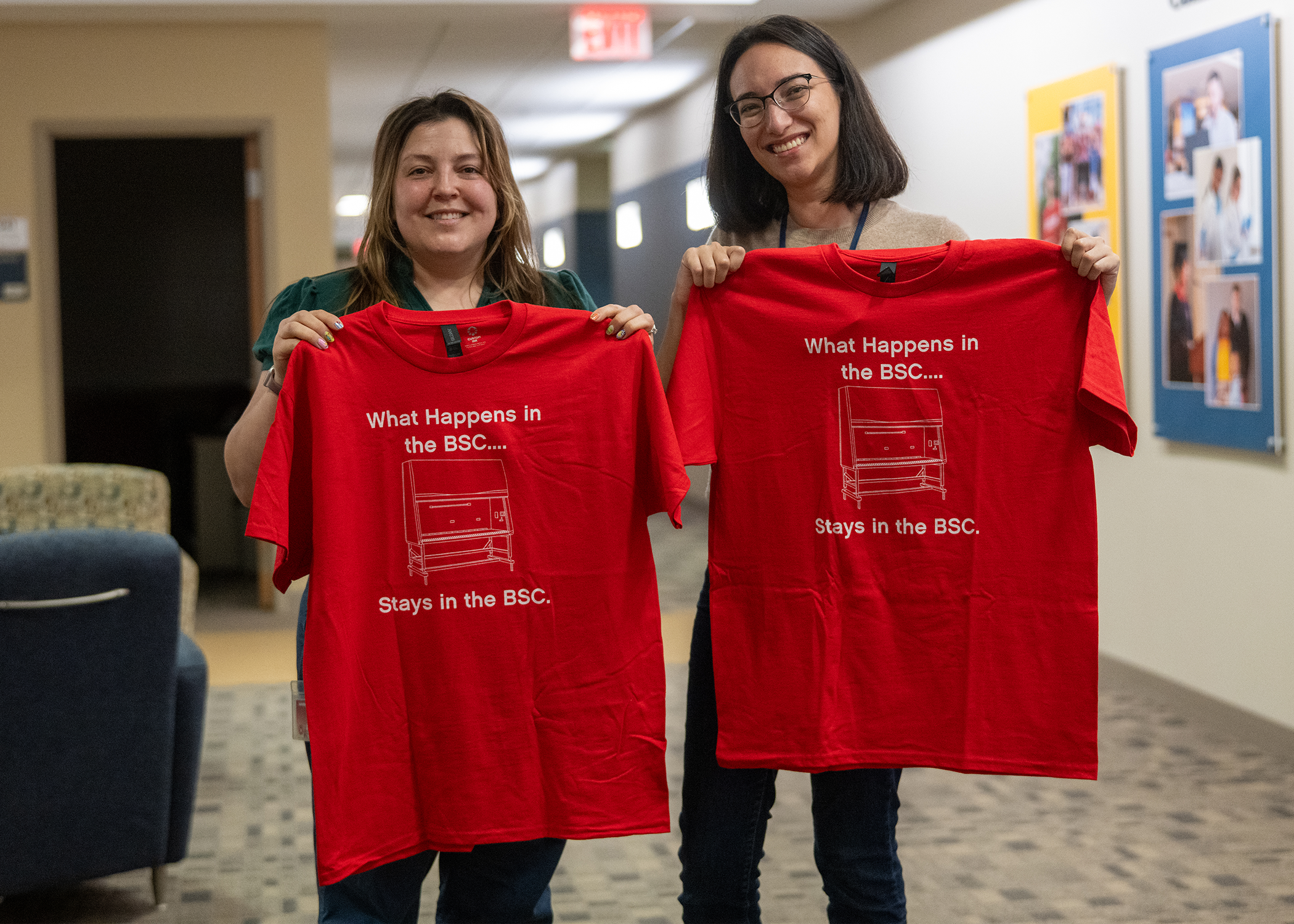
Now it’s your turn to share! This month, OBS is collecting safety moments from YOU to help support our research community. Please submit your example of a close call and your corrective follow-up action to biosafety@fpm.wisc.edu for a chance to win a free T-shirt!
We will be sending out one free shirt every week. At the end of the month, we will share more safety moment examples from your fellow researchers. Publicly shared info will be fully anonymous. Submissions will be shortened and edited as needed to remove all identifying information, including agent information. Identities of the winners will not be shared.
by Megan Dixon
Megan Dixon is a Biosafety Specialist on the IBC and Laboratory Operations team. She joined EH&S in 2024 and supports the research community through reviewing biosafety protocols, conducting risk assessments, and visiting laboratories.

It’s Biosafety and Biosecurity Month 2025! Look out for more biosafety topics each week in October.
This year’s Biosafety Month theme is Safety from Start to Finish.
Learn about the latest biological safety updates that impact labs like yours on the UW–Madison campus, and print the flyer to help spread the word.
Have a biosafety question? Need help? The UW-Madison Office of Biological Safety is ready to serve you!
The UW-Madison Office of Biological Safety is a proud member of the American Biological Safety Association (ABSA).