Isoflurane is the most widely used anesthetic gas used in animal research on campus. Isoflurane, sevoflurane, and other halogenated anesthetics present risks to the people working with them.
Although there is no specific data regarding the health risks of isoflurane in humans, halogenated anesthetics in general have been associated with reproductive problems. They cause skin and eye irritation and may cause drowsiness or dizziness. This page provides general guidance that applies to isoflurane and other halogenated anesthetics used in animal research.
This is an accordion element with a series of buttons that open and close related content panels.
Best Practices For Setting Up Anesthetic Vaporizers
Prior to beginning to work with Isoflurane, ensure the set up for procedures follows best practices.
PPE Requirements: Nitrile gloves, lab coat or disposable gown, and safety glasses/goggles should be worn when working with Isoflurane.
Where To Set Up For Use: It is best practice to set up the isoflurane vaporizer within a fume hood or approved biosafety cabinet (approved BSCs include ducted BSCs or BSC fitted with a charcoal filter). This provides the best protection to the user from the Isoflurane fumes. If the isoflurane vaporizer set up is too large to fit within the fume hood or approved BSC, it should be used in a well-ventilated area and a keyed bottle adapter or anti spill bottle pourer (see below) must be used for filling the vaporizer.
Training Resources:
- RARC provides training on the best ways to set up and use isoflurane vaporizers.
- ARS Compressed Gas and Anesthetics for Animal Users Training
Before Beginning:
- A waste gas canister is required when using an isoflurane vaporizer on a bench top or in a non-ducted BSC that is not vented through a waste scavenging system. See the “Fun with Charcoal Canisters” section for more information.
- Record the Charcoal Canister weight before use.
- Inspect all valves, hoses and connections for cracks or loose seals prior to use.
During Anesthesia:
- The levels of anesthesia used will vary based on species, animal age, strain, and individual responses. RARC provides an anesthesia formulary that includes dose ranges to use. Also refer to your approved animal protocol.
- In general, for rodents:
- Induction: ~4% Isoflurane
- Maintenance: 2% Isoflurane
- Oxygen:
- 0.5LPM per open non-rebreather circuit, i.e. 3 open circuits =1.5LPM
- Induction chambers may require 1-3 LPM, depending on size
- Check toe pinch reflex to ensure anesthetic depth
- Provide eye lube and heat to animal if procedure lasts longer than 5 minutes.
- Watch respirations during procedure and adjust isoflurane if necessary.
- Opening the induction chamber is when the user is exposed to the most isoflurane. Best practice is to open induction chambers in a fume hood or approved BSC. Flush the induction chamber with oxygen before quickly removing the sedated animal.
After Anesthesia:
- When disposing of the bottle of isoflurane:
- If there is only a trace amount of liquid remaining, you can off gas the bottle in a fume hood, then dispose of in the trash.
- If there is more than a trace amount, do NOT off gas the liquid. Please submit a request for pickup via the Chemical Disposal/Surplus Pickup Request Form.
Fun With Charcoal Canisters
Anesthesia waste gas canisters (commonly referred to as charcoal canisters) are used with anesthesia vaporizers to help prevent isoflurane exposure to users. Below are the four common types used on campus and how to set them up.
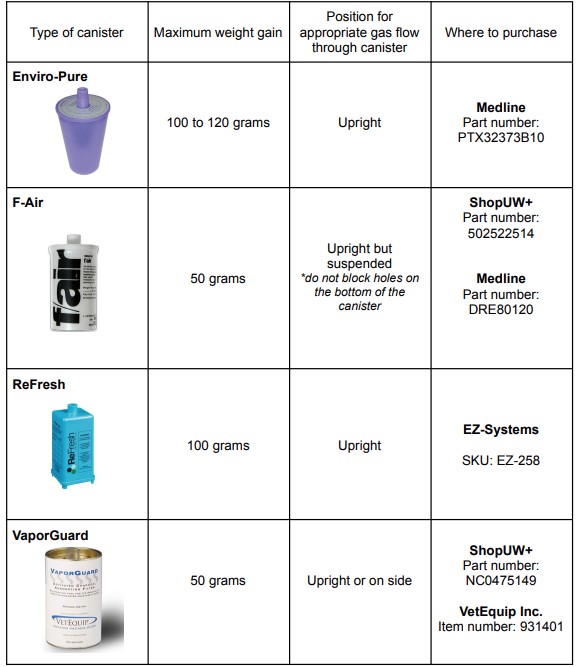
When To Replace:
- Charcoal canisters must be used in accordance with the manufacturer’s directions.
- Charcoal canister usage logs that track canister weights and/or usage times must be maintained and kept on file. Canister should be replaced when the total weight or time limit is met.
- Here’s a template for charcoal canister tracking log.
Disposal of Charcoal Canisters:
- Charcoal canisters can NOT go into the regular waste stream (i.e. trash). Charcoal canisters need to be picked up by EH&S Hazardous Waste team due to the disposal regulations of activated charcoal. Please submit a request for pickup via the Chemical Disposal/Surplus Pickup Request Form. Used charcoal canisters must be stored in the lab or animal facility until ready for pickup.
Drop Method and You
The Drop Method refers to an anesthesia option for rodent procedures requiring a brief loss of consciousness. It is not intended for surgical or prolonged exposure. Drop method can also be used for euthanizing rodents via an overdose of anesthesia.
PPE Requirements: Nitrile gloves, lab coat or disposable gown, and safety glasses/goggles should be worn when working with Isoflurane.

Where To Set Up For Use: Drop method should ALWAYS be performed in a fume hood or approved BSC.
During Use:
- Animals should never come into direct contact with the liquid isoflurane. To prevent this, the liquid isoflurane should be applied to a piece of gauze that is either placed within a tissue cassette or another physical barrier. [Insert pic of cassette with gauze here]
- Place the isoflurane soaked gauze inside a sealed chamber and allow at least 30 seconds for the chamber to equilibrate and charge with the isoflurane.
- Place the animal inside the chamber.
- Monitor the respiratory rate of the animal until the desired plane of anesthesia in reached.
- Remove the animal from the chamber and replace the lid.
After Use: Within the fume hood or approved BSC, open the chamber and allow it to off gas.
Monitoring Exposure for Users
EHS Environmental and Occupational Health (EOH) offers the following anesthetic gas services for UW–Madison students and staff:
- Anesthetic gas monitoring, hazard assessment, and guidance on minimizing exposures.
- Occupational Medicine schedules medical consults and respirator fit tests.
To access these services, contact Occupational Health (workplace assessments) eoh@fpm.wisc.edu
Phone: 608-890-1992
Additional guidance documents from EOH:
Additional Supplies and Information
- Anesthesia vaporizers are required to be certified annually. M and M Anesthesia is a potential option for annual Isoflurane Machine Certification: Contact info: iammajormike@yahoo.com
- Plastic containers are NOT appropriate for use with isoflurane as it will degrade the plastic.
- Isoflurane Anti-Spill Adapter ordering information:

-
- RARC Pharmacy: BIO-Isoflurane Anti-Spill Adapter
- Midwest Veterinary Supply: Item #685.02000.2; Item #715.75698.2; Item #350.11219.2
- Shop UW:
- Part Number-VWR: MSPP-VF-6230 (EA)
- Part Number- Fisher Scientific: NC3237201
Additional Resources:
ARS: Isoflurane and other halogenated anesthetics guidance document
ARS: Compressed Gas & Anesthetics for Animal Users training
RARC Anesthesia Training Course
RARC Anesthesia Machine Guide Training Course
RARC Inhalation Anesthesia Systems for Rodents Training Course
EOH: Waste Anesthetic Gas Scavenging Systems Guidance